Erasmus+ KA220-HED · 2026 – 2029

Building educators’ AI competence in designing Retrieval-Augmented Generation for teaching and learning in higher education

RAG4Edu empowers educators and students to move beyond generic AI tools and build their own pedagogically grounded RAG applications — with a competence-based curriculum, an open training programme, accessible tools and a European Community of Practice.

Higher education AI and data usage Digital literacy skills New learning and teaching methods
36 months1 Sep 2026 – 31 Aug 2029
6 partnersDE · ES · FR · FI · PT · UA
Open accessall results under open licences
€400,000Erasmus+ lump-sum grant
147 educatorssurveyed in the 2025/26 needs analysis

About the project

Why RAG, and why now

Large language models are entering teaching and learning fast, but their use is often ad hoc, prompt-based and weakly anchored in educational knowledge. That raises real concerns about reliability, accuracy, bias, transparency and data protection.

Retrieval-Augmented Generation (RAG) combines generative AI with curated, domain-specific knowledge sources — lecture notes, slides, scientific publications, exams, lab materials — so that AI support in a course is more controllable, explainable and context-aware. Educators across Europe, however, currently lack the training, pedagogical frameworks and institutional support needed to design and run RAG-based solutions.

RAG4Edu closes that gap. It develops a competence-based RAG curriculum and a modular training programme with micro-learning modules, group-based learning activities, accessible tools, templates and worked examples that let educators create their own RAG applications without advanced AI skills. Cross-country pilots validate the programme, and a European Community of Practice carries it beyond the project.

The project promotes European, values-aligned AI — EU-based LLMs and EuroHPC infrastructure, open licences, GDPR-compliant design and alignment with the EU AI Act — contributing to a digitally competent and sovereign European higher-education sector.

How RAG works

From course materials to grounded answers

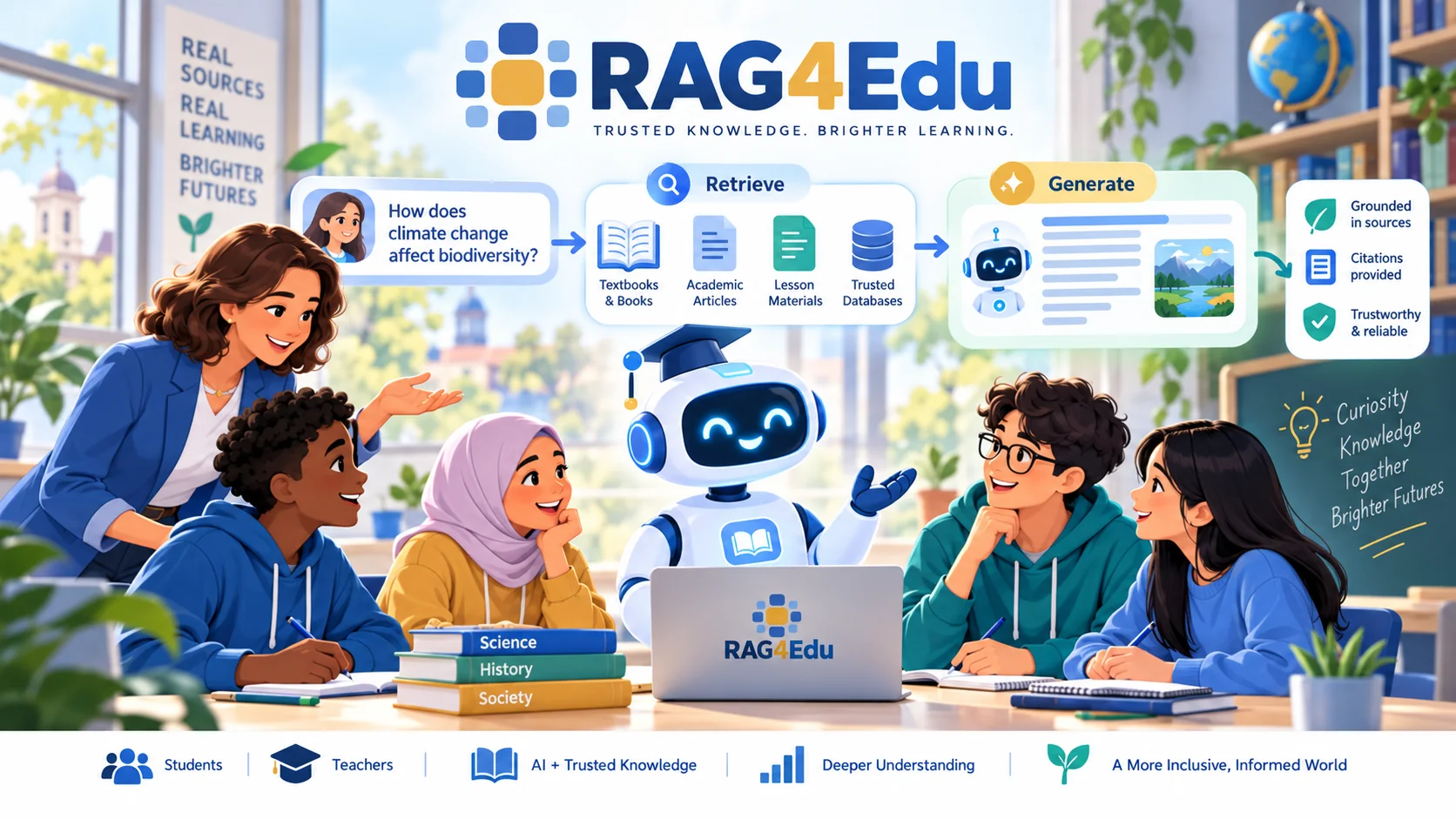
RAG combines generative AI with the knowledge sources an educator chooses, so AI support in a course is controllable, explainable and context-aware.

  1. 1Retrieve

    A learner’s question searches the course knowledge the educator has curated — lecture notes, slides, papers, exams — and returns the most relevant passages.

  2. 2Augment

    The retrieved passages and the learner’s profile are added to the prompt, so institutional knowledge shapes a relevant, context-aware response.

  3. 3Generate

    A European LLM writes the answer from that context and shows the sources it used, so learners can check every claim.

  4. 4For education

    Educators design and validate each step in the RAG4Edu Toolbox — with GDPR and AI Act checks, and without advanced AI skills.

Course knowledge slides · lecture notes papers · exams · datasets curated by the educator Ingest & index embeddings · metadata Learner question or group task Retrieve top-k relevant passages Augment prompt context + learner profile Generate European LLM Answer with cited sources Educator designs · validates GDPR · AI Act check no / low-code RAG4Edu pipeline: modular, documented, EU-hosted models, learner-aware augmentation. Educators build and configure it through the RAG4Edu Toolbox — without advanced AI skills.
Inside a course-specific RAG application: the educator curates the knowledge base, retrieval grounds every answer in it, and generation runs on European LLMs.

Why it can be trusted in a course

  • Grounded in sourcesAnswers are built on the knowledge base the educator curated for the course.
  • Citations providedLearners see which passages an answer draws on and can check them.
  • European and compliantEU-based LLMs and EuroHPC infrastructure, GDPR-compliant design, aligned with the EU AI Act.
  • Open and reusablePipeline, toolbox and templates are published under open licences.

Objectives

Five things the project sets out to achieve

RAG4Edu strengthens the capacity of European higher-education institutions to design, implement and evaluate RAG for teaching and learning in a pedagogically grounded, responsible and sustainable way.

European AI

A European, values-aligned AI solution

Promote European AI technologies — EU-based LLMs such as EuroLLM, Mistral and Aleph Alpha, and EuroHPC infrastructure — with transparency, explainability, accountability and data sovereignty, in compliance with the AI Act.

Pedagogy

A strong pedagogical foundation for RAG

Analyse the AI-in-education landscape, synthesise the state of RAG, and design the RAG4Edu Curriculum with competence levels, learning outcomes, instructional principles and micro-credentials.

Tools

Open, reusable RAG tools

Build the RAG4Edu pipeline and framework, learner-aware augmentation, AI-supported group formation, and an authoring toolbox for multilingual educational chatbots on European LLMs.

Training

A validated training programme

Design, pilot, evaluate and refine the RAG4Edu Training Programme in coordinated pilots across partner countries, generating evidence on effectiveness, usability and institutional feasibility.

Community

A sustainable European ecosystem

Run the communication platform and a European Community of Practice, publish everything open access, and secure adoption through a sustainability and exploitation strategy, multiplier events and a final European workshop.

Target groups

Who it is for

  • Educators across disciplinesProfessors, lecturers and researchers with teaching duties — the primary target group.
  • Their studentsWho gain RAG literacy through curricula and projects.
  • Teaching and learning centresWho embed the training in the professional development of university staff.

News and events

What is happening in RAG4Edu

Updates from the partnership, upcoming webinars, co-design sessions and multiplier events.

All news

Upcoming events

Partnership

Six institutions, six countries

Higher-education institutions with strong teacher-education and digital-pedagogy profiles, together with two of Europe’s leading AI research centres.

BHT

Berliner Hochschule für Technik (BHT)Coordinator

Berlin, Germany · bht-berlin.de

One of Germany’s largest public universities of applied sciences, with around 11,600 students. Its Data Science +X Research Center includes an AI + Education strand, and the Competence Center for Digital Teaching supports the use of AI in teaching.

Prof. Dr. Ilona Buchem · Prof. Dr. Klaus-Peter Schoeneberg

Artificial Intelligence Research Institute (IIIA-CSIC)

Barcelona, Spain · iiia.csic.es

An internationally recognised AI institute of the Spanish National Research Council, working on machine learning, multi-agent systems and reasoning. It coordinates AIHUB-CSIC, a network of more than 500 AI researchers.

Prof. Carles Sierra · Prof. Margarida Romero · Dr. Mireia Vendrell

UniCA

Université Côte d’Azur

Nice, France · univ-cotedazur.eu

A public research university with about 35,000 students. Its LINE laboratory studies educational innovation, co-creativity and critical thinking, and its MSc SmartEdTech combines computer science, education and cognitive science.

Prof. Dr. Oksana Strutynska · Chengcheng Li

University of Oulu

Oulu, Finland · oulu.fi

A Finnish research university founded in 1958. Its Learning and Educational Technology Research Lab (LET Lab) studies learning with multimodal data and human-AI collaboration, and the Hybrid Intelligence programme explores how humans and AI learn together.

Dr. Andy Nguyen · Prof. Sanna Järvelä · Dr. Luna Huynh · Azusa Nakata

INESC
ID

INESC-ID

Lisbon, Portugal · inesc-id.pt

A non-profit research institute in computer science and engineering, jointly owned by Instituto Superior Técnico and INESC. Its Group of Artificial Intelligence for People and Society (GAIPS) works on intelligent agents, social robotics and technology-enhanced learning.

Prof. Ana Paiva · Prof. Rui Prada · Prof. Joana Campos

Dragomanov Ukrainian State University

Kyiv, Ukraine · udu.edu.ua

A long-established Ukrainian university with a strong tradition in teacher education and pedagogical research, and a growing focus on digital transformation, AI and educators’ digital competences.

Dr. Mariia Umryk · Daniil Shemet

Partner profiles and team

Associated partners

EATELEuropean Association of Technology Enhanced Learning Knowledge Innovation CenterMalta · EU policy and AI frameworks KI-CampusGermany · learning-platform integration University of LisbonPortugal · pilot support mycelia gGmbHGermany · digital credentialing

Advisory board

Dr. Davide TaibiInstitute for Educational Technologies, CNR, Italy Prof. Barbara WassonSLATE, University of Bergen, Norway Prof. Olga VibergKTH Royal Institute of Technology, Sweden · EATEL President

Results

Everything we produce is open

All core results are published under open licences in repositories such as Zenodo and GitHub, with persistent identifiers and FAIR metadata. Links will appear here as each result is released.

A2.1-R1

State of AI in Education — analysis report

International policies, AI-literacy frameworks and research trends across the EU, China, the USA and partner countries; at least 50 sources reviewed.

In progress
A2.2-R1

RAG landscape synthesis report

RAG architectures, tools and educational applications, a comparative RAG-tools matrix, and the core RAG competences that underpin the micro-credentials.

Planned
A2.3-R1

RAG4Edu Curriculum and RAG-Pedagogy Framework

Competence-based learning outcomes, instructional design principles, micro-learning modules, flexible pathways and micro-credentials as open badges.

Planned
A3.1-R1

Group Formation Design Framework and tool

Criteria, data sources, decision logic and transparency mechanisms for AI-supported group formation, with collaborative learning design templates.

Planned
A3.2-R1–R3

RAG4Edu Pipeline and Framework

Conceptual and technical specification, a deployable operational prototype (ingestion, semantic retrieval, generation) and learner-aware augmentation mechanisms.

Planned
A3.3-R1

RAG4Edu Chatbots and Toolbox

Authoring tools to create and configure course-specific RAG chatbots and agents, multilingual case-study applications, templates and documentation.

Planned
A3.4

Integration and support services

Specification and integration of EU-based LLMs and AI services, embeddings, token management and compliance features for the pilots.

Planned
A4.1-R1

RAG4Edu Training Programme

Open online programme combining expert-level RAG content, flexible pathways, OERs, competence-based assessment and micro-credentials.

Planned
A4.2-R1

Pilot protocol and cross-site pilots

Participant selection, implementation guidelines, evaluation framework and data plan applied consistently across partner institutions.

Planned
A4.3-R1

Evaluation, refinement and adaptation report

Evidence from all pilots, lessons learned, and action points for improvements, translations and national adaptations.

Planned
A5.1-R1

Communication and collaboration infrastructure

This website and the linked repositories — the project's open digital hub for outputs, events and dissemination material.

In progress
A5.2-R1

RAG4Edu Outreach Pillars

A European Community of Practice with recurring thematic webinars, participatory co-design sessions and institutional roundtables.

Planned
A5.3-R1

Open-access repositories and reuse framework

Adaptation guidelines, licensing clarity and transfer models so other institutions can implement RAG4Edu results independently.

Planned
A5.4-R1

Sustainability, adoption and exploitation strategy

At least three concrete post-project pathways: institutional teacher-training programmes, digital strategies and external networks.

Planned
A5.5-R1

Multiplier events and final European workshop

A national multiplier event in every partner country and a final workshop as a pre-conference event at a leading AI-in-education conference.

Planned
≥ 500platform users from European countries
≥ 150Community of Practice members from at least 8 countries
≥ 250educators and stakeholders reached through multiplier events
≥ 80 %of participants rating results relevant and useful

Community of Practice

Teaching with RAG? Curious how to start? Join us.

The RAG4Edu Community of Practice brings together educators, teaching and learning centres, innovation hubs and researchers across Europe — with webinars, co-design sessions and institutional roundtables from late 2026. Results are also shared through the European Digital Education Hub, EPALE, OpenAIRE and Zenodo.

One free RAG4Edu account gives you the members’ area of this website and the courses on the RAG4Edu learning platform.

Project coordinationProf. Dr. Ilona Buchem · Berliner Hochschule für Technik (BHT), Germany
Website and Community of PracticeDr. Andy Nguyen · University of Oulu, Finland